 Field

Before first light, a Carolina creek bottom can sound empty enough to hear frost settling on the leaves. Then one coyote opens up from a cutover, another answers near the hardwood ridge, and the whole pack breaks loose. That racket is no longer a Western sound. Coyotes in the southeast have become part of the landscape, from North Carolina tobacco country to Georgia pine plantations and Alabama cattle ground.
Hunters call them song dogs for good reason. One minute the woods are still. The next, a handful of coyotes can sound like twenty. Their yips, barks, and drawn-out howls travel a long way through bare timber, especially on a cold January night when the air lies heavy in the bottoms.
They are sharp, adaptable predators. They live behind subdivisions, cross soybean fields after dark, den near old logging decks, and slip past deer stands without leaving much more than a narrow track in the mud. Understanding how they got here, how they use Southern cover, and why they hold such a strong place in wildlife art starts with seeing the animal clearly. No campfire exaggeration. No cartoon villain. Just a capable predator making a living on difficult ground.
A Western Voice Crossed the Mississippi and Kept Moving
The coyote was once associated mainly with open country west of the Mississippi. As wolves and other large predators disappeared from much of the continent, coyotes gained room to expand. Farming, timber cutting, road systems, and fragmented habitat helped them move. They followed river corridors, brushy rights-of-way, railroad beds, and the broken edge cover created by people.
That movement did not happen in one clean wave. Coyotes reached eastern country through more than one route over decades. Some northern populations mixed with wolves and domestic dogs farther up the continent, which helped create the heavier eastern animals hunters sometimes hear about. That does not mean every big Carolina coyote is half wolf. Body size varies with genetics, age, sex, food supply, and the way thick winter fur changes an animal’s outline.
The story of coyotes in the southeast is mostly a story of adaptability. These animals did not wait for the land to resemble a Wyoming basin. They learned to use pine thickets, grown-up fence lines, swamp edges, poultry country, and patchwork farms. They found rodents in hayfields, rabbits in briar tangles, fawns in spring cover, persimmons in early fall, and carrion wherever the opportunity appeared.
That broad diet matters. A coyote is not built around one food source. It can hunt, scavenge, or eat seasonal plant matter. When one meal gets scarce, it shifts to another. That flexibility is a big reason trapping and coyote hunting may reduce local numbers for a time without removing coyotes from the wider landscape. Nearby animals can move into good vacant territory, and surviving pairs can adjust their reproduction when populations are pressured.
By the time many Southern deer camps started paying serious attention, coyotes were already established. Hunters began finding tracks along logging roads, hearing packs behind food plots, and catching them on trail cameras during the last quiet minutes before dawn. The newcomer had turned into a permanent neighbor.
The Piedmont Gave the Song Dog Everything It Needed
Walk a typical piece of Carolina Piedmont ground and you will see why a coyote stays. A hardwood branch drains into a creek. A beaver pond backs water into a stand of sweetgum. Above it sits a clear-cut, a young pine plantation, or a cattle pasture with a ragged fence line. Add a few hayfields, chicken houses, old barns, and two-lane roads, and you have travel lanes, bedding cover, water, and food packed close together.
Coyotes favor edges, but that does not mean they always walk in the open. In daylight, a pressured animal may stay one or two rows inside a pine stand, using the field edge without exposing itself. It may follow the downwind side of a logging road rather than step into the roadbed. Around deer season, coyotes quickly learn that trucks, gates, and human scent often lead to trouble.
Creek bottoms deserve special attention. They connect blocks of cover while hiding movement from roads and houses. Sandbars and muddy crossings also preserve tracks, which makes them useful scouting locations. A coyote can travel a branch, climb through a saddle, circle a food plot, and disappear into planted pines without crossing much open ground.
Young cutovers provide another stronghold. Rabbits, mice, songbirds, insects, and browse-loving deer all use that thick regrowth. Coyotes can bed on a dry knob, watch an opening, and leave through cover too dense for a person to follow quietly. After a few seasons, the same cutover becomes a maze of saplings and blackberry canes where an animal can vanish at twenty yards.
That adaptability is why coyotes in the southeast show up in such different places. One pack may work remote mountain hollows. Another may live between a golf course and a four-lane highway. In farm country, they often make nighttime loops around calf lots, silage pits, hay barns, and poultry operations. Near towns, they use drainage easements and wooded strips as hidden roads.
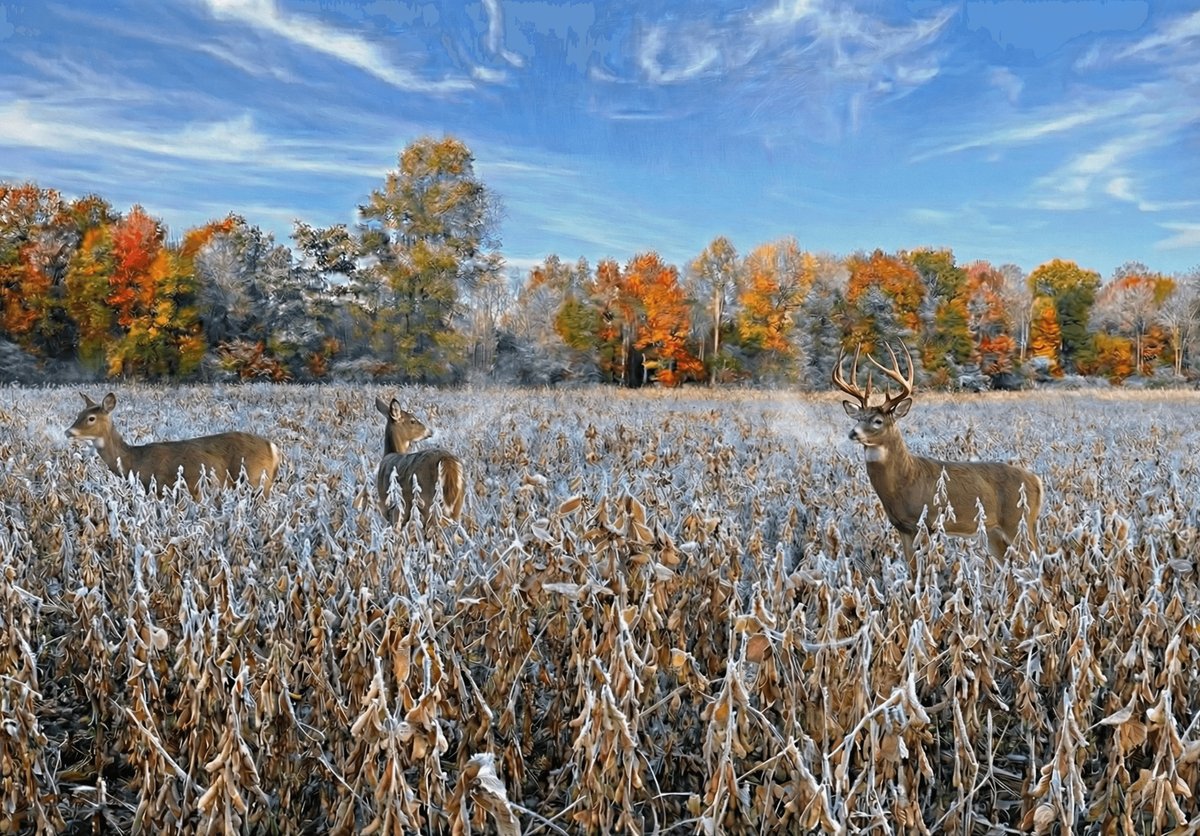
The best comparison may be the whitetail. Both animals understand pressure. Both learn where people enter the woods. Both use wind and terrain better than most hunters admit. If you spend your fall studying funnels and bedding cover for deer, you already understand much of the ground a coyote prefers. Our whitetail deer prints show that same Southern mixture of edge, cover, and watchfulness from the prey animal’s side of the story.
Tracks, Scat, and Silence Tell You Where They Travel
Hearing a pack does not tell you exactly how many coyotes are present, and it does not mark the spot where they will stand tomorrow evening. Sound carries, especially across water and open fields. A few animals changing pitch can create the impression of a much larger group. Treat a howl as a clue, not a head count.
Tracks give you firmer information. A coyote print usually looks tighter and more oval than the splayed track of many domestic dogs. The two center toes tend to point forward, and claw marks may show in good mud. On a steady travel line, the animal often moves with purpose. Wandering dog tracks are more likely to loop around, investigate everything, and mix with obvious human activity.
Scat commonly appears on logging roads, intersections, field entrances, and other visible travel features. Coyotes use it for communication, so they often leave it where another animal is likely to notice. Hair, bone fragments, seeds, or fruit skins can reveal what they have been eating, though one dropping never describes the whole local diet.
Trail cameras help, but placement matters. A camera pointed across a wide food plot may catch a distant blur and little else. Set cameras at creek crossings, fence gaps, logging-road junctions, or the narrow strip between thick bedding cover and an open field. Mount them low enough for a coyote-sized animal, clear weeds that will trigger empty pictures, and pay attention to direction of travel.
Time stamps can expose a pattern. If the same coyote crosses a gap just after midnight every few days, it may be making a larger circuit. If different animals appear near dawn, the location may be close to a bedding area or a regular feeding route. Daylight pictures are especially valuable because they identify places where a calling setup has a realistic chance.
Do not overlook what other wildlife tells you. Crows gathering in one corner of a pasture may have found carrion. Nervous cattle can point toward movement along a fence. Turkeys suddenly pitching out or avoiding a familiar field may be reacting to predators, people, or another disturbance. If spring woods are what keep you scouting after deer season, our wild turkey prints carry the look of those hardwood ridges, strut zones, and early green fields.
Good scouting also means knowing when to leave. You can walk every road, check every thicket, and spread enough scent to make a mature coyote avoid the area for days. Find the high-value sign, study the wind, and back out. The same restraint that helps on an old buck helps on a song dog.
A Careful Calling Setup Beats More Noise
Coyote hunting in Southern timber is usually a close-range game compared with hunting open Western country. You may have only a narrow shooting lane, a gas line, or forty yards of visibility beneath mature hardwoods. That makes the setup more important than the volume or price of the call.
Start with the wind. A responding coyote will often try to reach the downwind side before committing. If that downwind route runs through an impenetrable pine thicket, the animal may scent you without ever showing itself. Use a creek, pond, steep bluff, open pasture, or road as a barrier when possible. You are not preventing every circle. You are steering the likely approach toward a place you can see.
Thermals matter in broken terrain. Cool morning air tends to drain toward bottoms, while warming air can rise along slopes. A stand that seems correct according to the weather app may still send your scent down a branch or swirl it through a hollow. Check the actual air at the setup. A light wind indicator tells the truth faster than a forecast.
Enter quietly and avoid crossing the opening where you expect an animal to appear. Park farther away than feels convenient. Shut doors gently. Keep headlamps low. In farm country, normal vehicle traffic may not bother a coyote, but an unfamiliar truck stopping at an unusual gate can change the whole set.
Calls should match the season and the mood of the ground. Prey distress sounds can work throughout the year. Coyote vocals become especially useful around breeding and territorial periods, but more noise is not always better. A lone howl, a pause, and a short distress sequence often sound more believable than twenty straight minutes of electronic chaos.
A practical calling kit can stay simple:
- A dependable call: Mouth call, electronic caller, or both, with sounds you can operate without fumbling.
- Wind checker: Fine powder or another lightweight indicator for reading small shifts.
- Shooting support: Bipod or sticks suited to sitting positions and uneven Southern ground.
- Compact seat: Enough insulation to keep you still on cold clay or damp leaves.
- Rangefinder and light: Useful where legal, with batteries checked before leaving the truck.
Place an electronic caller away from your body when the terrain allows. That puts the coyote’s attention somewhere other than your position and may buy a second when it reaches cover. A subtle decoy can help in an open field, but movement can also make cautious animals stop short. Use one because the setup calls for it, not because it came in the bag.
Give the stand enough time. In tight cover, a coyote may take a slow, suspicious route. Watch the downwind edge and every small opening. Many hunters miss the animal that appears silently while they are reaching for the remote. If crows, hawks, or owls begin investigating the sound, stay ready. Raptors often respond to the same commotion, and our raptor prints reflect those sharp-eyed hunters that share the field and timber.
Always confirm current state and local regulations before hunting. Seasons, night-hunting rules, artificial-light restrictions, weapon requirements, and access rules can change. Know the target, the background, nearby roads, livestock, and houses. Calling predators does not excuse a rushed shot.
The Same Wild Tension Belongs on Canvas
A coyote makes strong wildlife art because it never looks completely at rest. Even when standing still, the animal seems to be listening beyond the edge of the frame. The ears angle toward a sound. The nose tests the air. The body holds just enough tension to suggest that one wrong movement will send it into cover.
Good coyote wall art should capture more than fur and teeth. The setting carries half the truth. In the South, that may be a broomstraw field under a cold moon, a red-clay road slipping between pines, or a hardwood ridge washed in the last copper light of evening. Those places are familiar to anyone who has climbed into a stand before daylight and listened to howls roll through a bottom.
Moonlight fits the animal particularly well. It turns ordinary farm edges into something older and wilder. Tree lines flatten into dark shapes. Frost catches a little silver. A coyote lifting its muzzle against that sky becomes a symbol of survival without needing to look mean or theatrical.
That is the idea behind Howl Under The Harvest Moon. The piece focuses on the moment hunters know: a song dog outlined against warm autumn light, calling across ground that looks quiet until you understand what moves through it after dark. It works in a hunting room, cabin, office, or den because the scene carries atmosphere without turning the animal into a mascot.
Scale should match the wall and viewing distance. A 12×8 canvas fits a small shelf grouping or tight office corner and starts at $9.99. An 18×12 or 24×16 print gives the scene more room above a desk or side table. On a broad wall over a sofa, gun cabinet, or lodge-style console, 30×20 and 36×24 sizes create a stronger presence. Measure the available space instead of guessing from a product photo.
Coyote art also pairs naturally with other pieces that share the same land. A creek-bottom whitetail, a turkey in spring hardwoods, or a marsh scene can build a fuller picture of the Southern outdoors. If your camp leans more toward flooded timber and winter mornings, explore the waterfowl collection. For art focused on the ground itself, from fields to ridges and changing light, the landscape prints make a steady companion to wildlife subjects.
The point is not to decorate a room with random animals. Choose scenes that feel connected to your own ground. Maybe you remember a coyote cutting across a bean field during the rut. Maybe you heard a pack answer while walking out after an evening sit. The right canvas keeps that particular feeling in the room long after the season closes.
Questions Hunters Ask About Southern Coyotes
What is the best time of year for coyote hunting in the South?
Late winter is a strong period because vegetation is thinner, food can be less predictable, and territorial or breeding behavior may make coyotes more responsive to vocals. Deer season pressure has also provided fresh carcasses and gut piles in some areas, which can shape travel patterns. That said, coyotes can be called throughout the year where seasons and local rules allow.
Time of day depends on pressure and cover. First light and the final hour before dark are practical starting points. Overcast, cold, breezy days can produce movement later into the morning. Night hunting may be productive where legal, but you must understand the rules for lights, thermal equipment, weapons, and landowner permission. Check regulations before every season rather than relying on what was legal last year.
Do coyotes ruin deer and turkey hunting?
Coyotes can kill deer, especially fawns, and they will take turkey poults, eggs, and adult birds when the opportunity arises. But predator-prey relationships are not explained by one trail-camera picture or a single pile of feathers. Habitat quality, weather, disease, mast production, nesting cover, hunter harvest, and other predators all affect deer and turkey numbers.
Targeted predator control may help in a defined area, particularly when paired with strong habitat work. It is not a substitute for fawning cover, secure nesting habitat, thoughtful harvest decisions, and good land management. If you remove coyotes but leave the property as bare pasture and open mature timber, you have not fixed the lack of escape cover. Work on the whole system.
What size coyote canvas works best in a hunting room?
Start with the wall, not the animal. A 12×8 works well in a small grouping, on a narrow wall, or near shelves holding calls and old photographs. An 18×12 or 24×16 suits many offices and compact hunting rooms. For a main wall viewed from across the room, 30×20 or 36×24 gives the landscape and the coyote enough visual weight.
Leave breathing room around the canvas and consider nearby furniture. A print should not look stranded above a wide sofa or crowded between cabinets. If you are building a group, keep the horizon lines, color palette, or subject matter connected. The result will feel like one story about your ground rather than a row of unrelated pictures.
Coyotes are here to stay. You can study their tracks, hunt them carefully, respect what they do well, and still hold firm opinions about predator management. If the song dog has become part of your own woods, browse the full collection of wildlife and outdoor canvas prints and find a scene that looks like home.